Storage and reconstitution of peptides
A laboratory protocol for storing lyophilised peptides, preparing solutions, calculating concentration and preventing degradation.
Key findings
- Lyophilised peptides are most stable at −20 °C, protected from moisture and light.
- After reconstitution, the solution should be kept at 2–8 °C and used within the period specified in the protocol.
- Repeated freezing and thawing accelerates degradation.
- Concentration calculations must take into account the actual peptide content, not only the nominal mass.
Peptides are fragile molecules. A few minutes at the wrong temperature, exposure to light or repeated freezing can reduce their quantity and change an experiment’s results.
This article describes good laboratory practice for storage and reconstitution. It is not a human-use guide and does not replace your institutional protocol.
Why do peptides degrade?
The most common mechanisms are:
- hydrolysis of the peptide bond, especially at unsuitable pH;
- oxidation (methionine, cysteine and tryptophan are particularly sensitive);
- deamidation of asparagine and glutamine;
- aggregation and adsorption to surfaces;
- microbial contamination in solutions;
- photodegradation on exposure to light.
Each depends on temperature, pH, concentration and time.
Storing lyophilised peptide
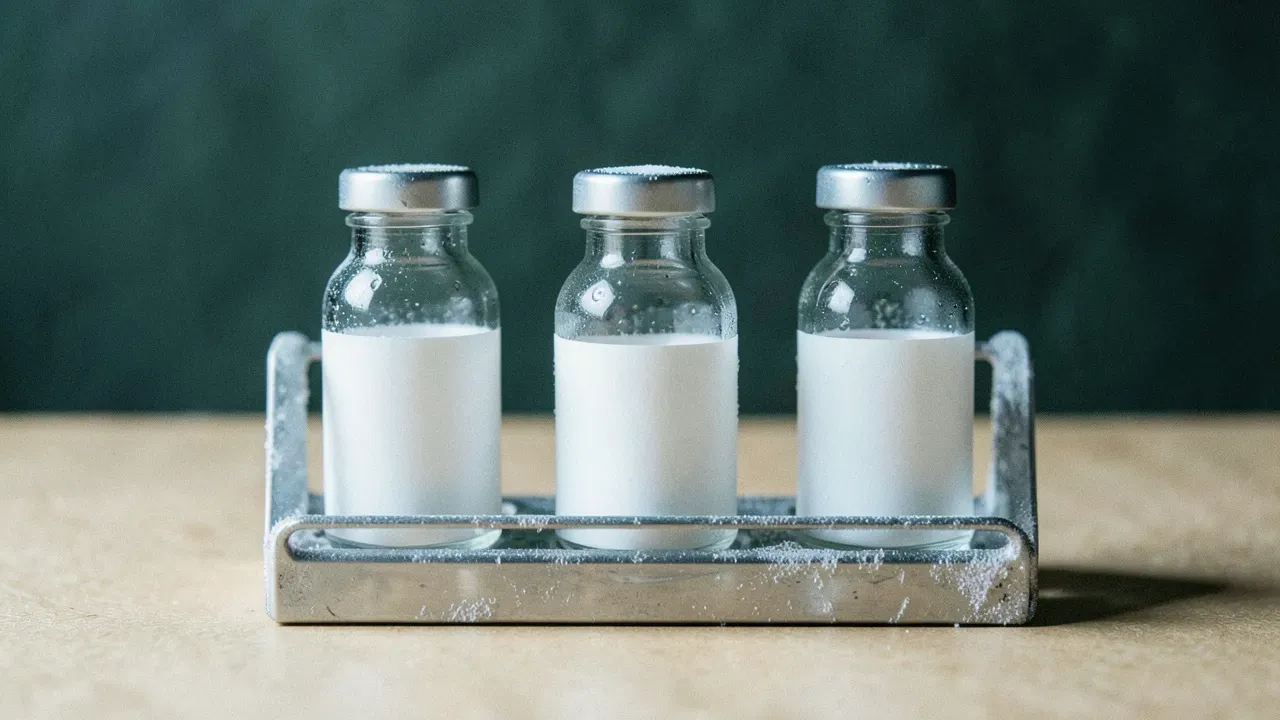
Lyophilisation removes water and increases stability, but the product does not last forever. Recommendations:
| Condition | Recommendation |
|---|---|
| Temperature | −20 °C for long-term storage |
| Moisture | tightly closed vial, preferably with a desiccant |
| Light | protection from UV and strong light |
| Cycles | as few openings and re-coolings as possible |
| Shelf life | observe the date on the vial and the COA |
Important: condensation
When you take the vial out of the freezer, moisture may condense on it. If you open it immediately, moisture enters the vial. So let it reach room temperature before opening, or wipe it and open it in a dry environment.
Aliquots
If you use the vial several times, it makes sense to prepare aliquots in the dry state or in solution, depending on the peptide’s stability. Label each aliquot with:
- the peptide name;
- the batch number;
- the concentration;
- the date of preparation;
- the preparer’s name.
Reconstitution: basic steps
Reconstitution means adding solvent to the lyophilised powder to produce a solution of known concentration.
1. Preparing the environment
- Use a clean work surface, preferably a laminar flow hood.
- Wear appropriate personal protective equipment.
- Prepare sterile solvent and sterile equipment.
- Record the batch of the peptide and of the solvent.
2. Calculation
Basic formula:
concentration (mg/mL) = mass of peptide (mg) / volume of solvent (mL)
Example: dissolve 5 mg of peptide in 5 mL of solvent → 1 mg/mL.
If you want a different concentration, adjust the volume. Always take into account the actual peptide content (with water and salt deducted), if stated.
To convert between mass and moles, calculate molar concentration and dilute according to C1V1 = C2V2, you can use the laboratory converter. The peptide calculator is available for concentration, amount and volume of solution. Both are intended for laboratory calculations, not dosing in humans.
3. Adding the solvent
- Add the solvent slowly, down the vial wall, not directly onto the powder in a strong stream.
- Do not shake vigorously; vigorous mixing can cause foaming and aggregation.
- Swirl the vial gently or use gentle mixing until the powder dissolves.
- If necessary, leave it for a few minutes at room temperature.
4. Checking
- The solution should be clear and particle-free.
- Record the appearance and any deviations.
- Label the vial with the date and concentration.
Storing the solution
After reconstitution, stability is usually shorter. General recommendations:
- keep at 2–8 °C, protected from light;
- use within the period specified by the protocol or literature for that peptide;
- do not freeze and thaw repeatedly;
- visually check clarity before each use.
Some peptides are more stable when frozen in aliquots, others are not. There is no universal rule — the decision must be based on data for the specific molecule.
Common mistakes
- Opening the vial immediately after taking it from the freezer → condensation.
- Vigorous shaking → foaming and aggregation.
- Using the wrong solvent → incomplete dissolution or degradation.
- Unlabelled solutions → loss of traceability.
- Refreezing → degradation cycles.
- Exposure to light → photodegradation.
- Ignoring the actual content → incorrect concentration.
Troubleshooting
| Problem | Possible cause | What to do |
|---|---|---|
| Powder does not dissolve completely | wrong solvent, pH, aggregation | check the protocol and pH; do not heat blindly |
| Solution is cloudy | particles, contamination, precipitation | do not use; prepare a fresh solution |
| Foam forms | shaking too vigorously | mix gently, wait for the foam to disappear |
| Colour changes | oxidation or moisture | discard or analyse; check storage |
| Results are not reproducible | degradation, incorrect concentration, adsorption | check the calculation, batch and materials |
If the problem persists, analyse rather than guess.
Safety and compliance
Research peptides are not medicines. Working with them requires:
- knowledge of the safety data sheet;
- adequate ventilation and protection;
- proper waste handling;
- compliance with institutional and national regulations.
If you are involved in clinical use, this is not your protocol — you need approval, pharmaceutical preparation and professional supervision.
Conclusion
Good laboratory practice is not bureaucracy but part of the experiment. A peptide that has degraded because of incorrect storage will give incorrect results — no matter how well the study was designed.
For a starting point on quality, read about the certificate of analysis and analytical methods.
Frequently asked questions about this topic
Can I store a peptide in a freezer?
Which solvent should I use?
What should I do if the solution is cloudy?
How to cite
RuskiPeptidi Editorial Team. (2026). Storage and reconstitution of peptides. RuskiPeptidi.com. https://ruskipeptidi.com/blog/storage-and-reconstitution-of-peptides/
Editorial policy
The content is reviewed and sourced. If you find an error, let us know — we will publish a correction.
How we prepare contentSources
RuskiPeptidi Editorial Team
Content is prepared by the RuskiPeptidi.com editorial team based on primary scientific sources, regulatory documents and manufacturer data. Every article is reviewed before publication, and sources are listed at the end of the text.
Editorial policy and sources